


Last November when gold was at $1,750, I wrote an article highlighting my bullish thesis. Revisiting that, I still believe Gold is the best risk adjusted trade for the next 12 months, regardless of your views on recession vs. soft landing.
Gold and real interest rates are nearly 1:1 inversely correlated.
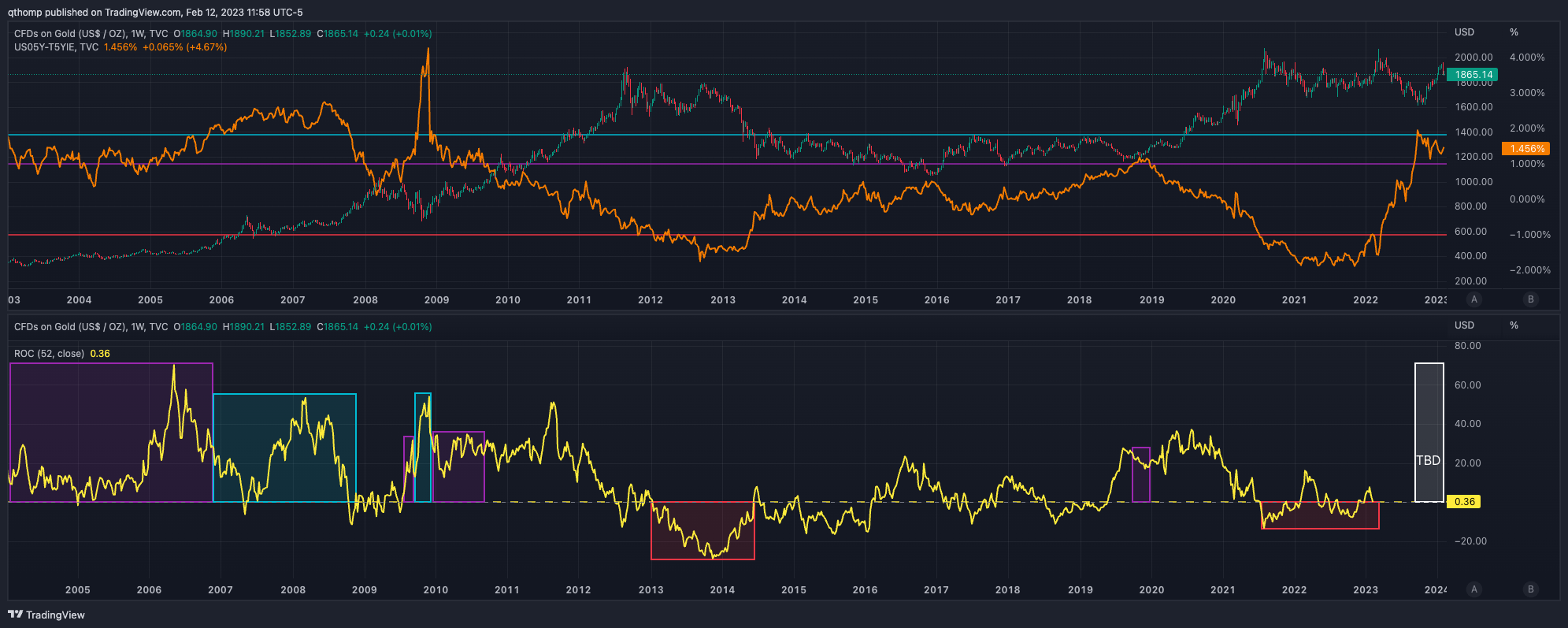
Real rates, typically measured on a 5 or 10 year basis, are nominal rates less inflation expectations. When real rates are falling, gold rises, and vice versa. The top pane of the chart below shows gold (candles) vs. real rates (orange). The horizontal lines represent real rates at different levels: +2% (blue), +1% (purple), -1% (red). The yellow line in the bottom pane shows the forward 12 month % returns of gold. You can see that when real rates are positive 1-2%, gold tends to return 10-40% over the following 12 months. We’re between that 1-2% band today. Inversely, when real rates are -1% or lower, gold tends to have its worst performance, -10-20% over the ensuing 12 months. Note this chart only goes back to 2003 as that’s when Trading View’s real rates data goes back to.
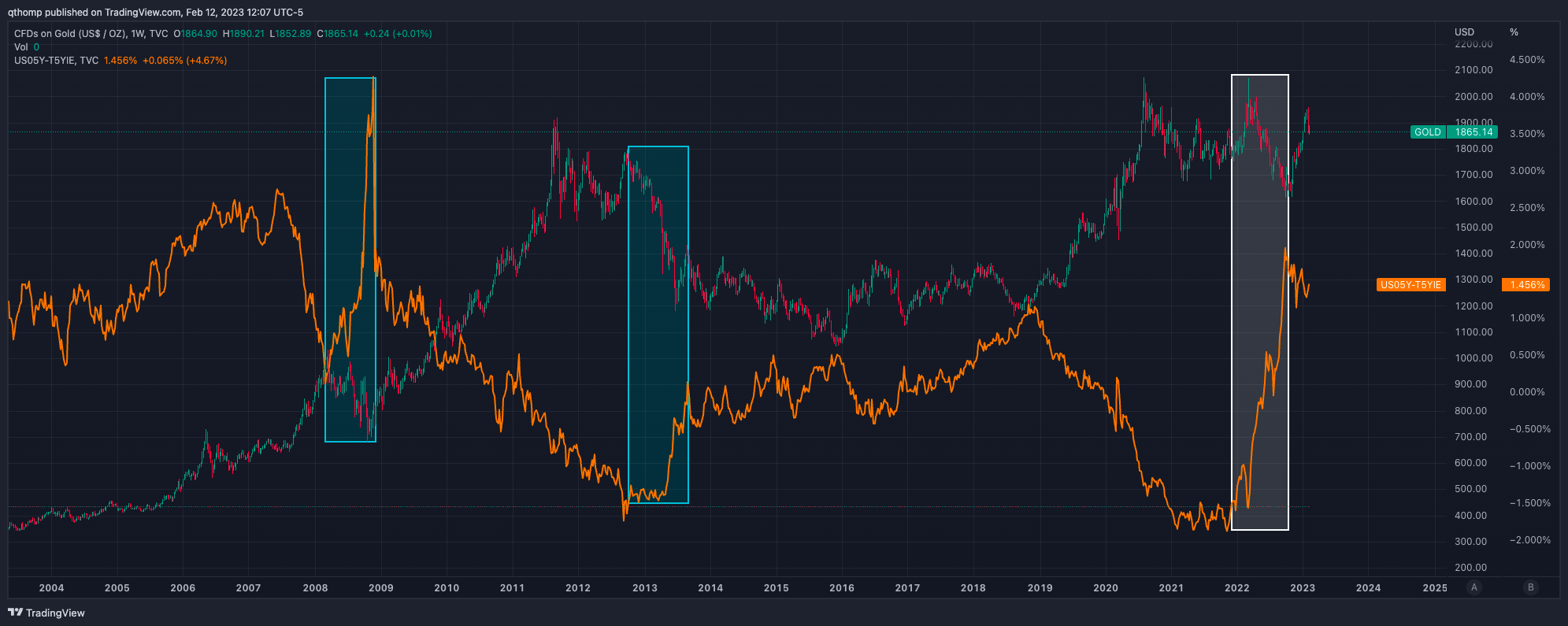
I would like to also point out how the post-COVID period has differed from previous rising real rate environments. In 2008 and 2013 we saw real rates rise and gold in both periods fell over -30%. Contrasting that with 2022, real rates increased at a historic pace, rising ~400 bps, yet gold only fell ~15%. My takeaway there is that gold is aware of the constraints of today’s economy - positive real rates are not sustainable. The risk now skews towards inflation and the Fed will be forced to resume QE before inflation will come down.
Interest rates broadly and the Fed hiking cycle in particular will not reaccelerate unless inflation does first.
With the yield curve at historically inverted levels, the market is saying that however high short-term interest rates go, they will not stay elevated for long. If the economy is slowing into a recession of any severity, rates are at or near peak as we know the monetary and fiscal stimulus playbook that would ensue in that scenario (QE, rate cuts, MMT).
Where there may be disagreement is whether or not we get a soft landing and if so, what will inflation do. This answer is the key to real rates and gold. If real rates are flat (i.e. inflation expectations and nominal rates move in lockstep, gold will perform similarly to treasuries). If real rates are falling, gold outperforms treasuries.
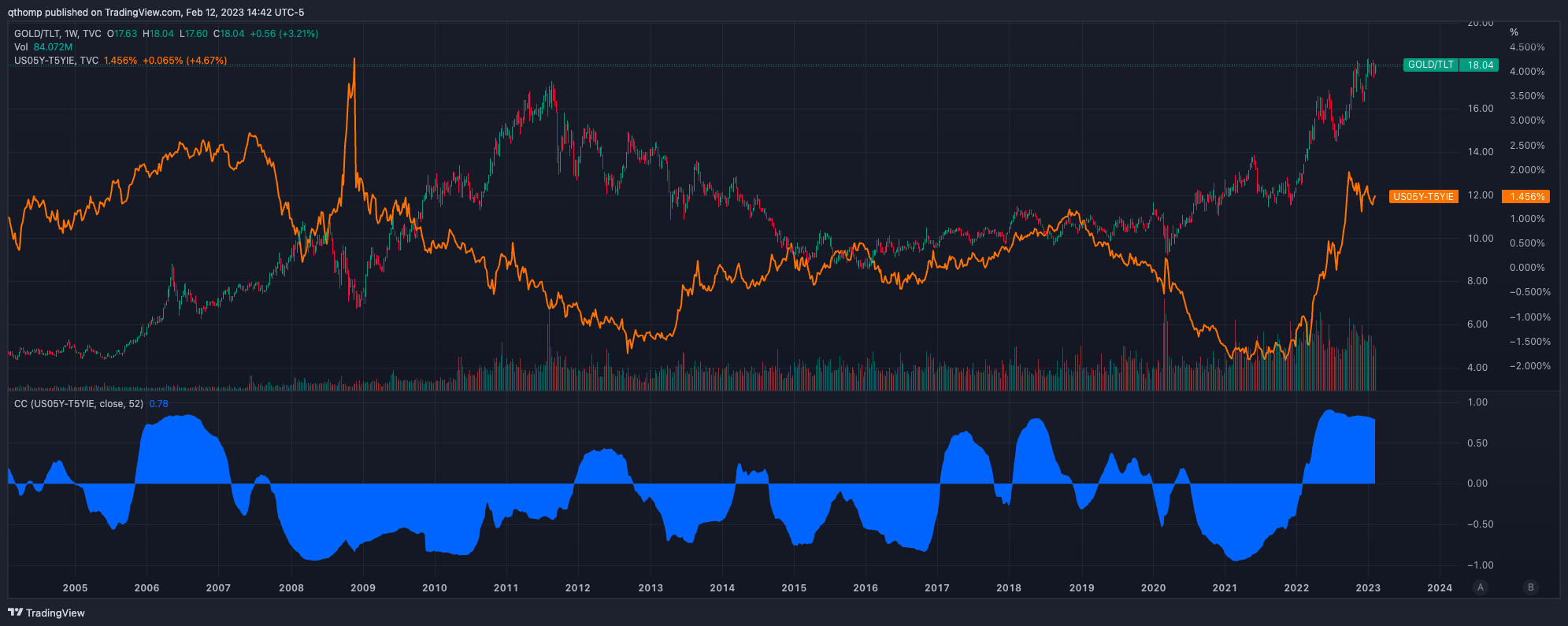
The above chart shows gold / TLT (candles) vs. real rates (orange) and their correlation below in blue. Similar to gold’s absolute performance as of late called out above, I would like to also highlight it has never outperformed treasuries to this extent in a period of rising real rates. Again, this points to the constraints of today’s economy - the Fed will be forced to resume QE before inflation will come down.
Let’s walk through the potential scenarios:
Nominal rates rising
Faster than inflation expectations - real rates higher, gold lower
Slower than inflation expectations - real rates lower, gold higher
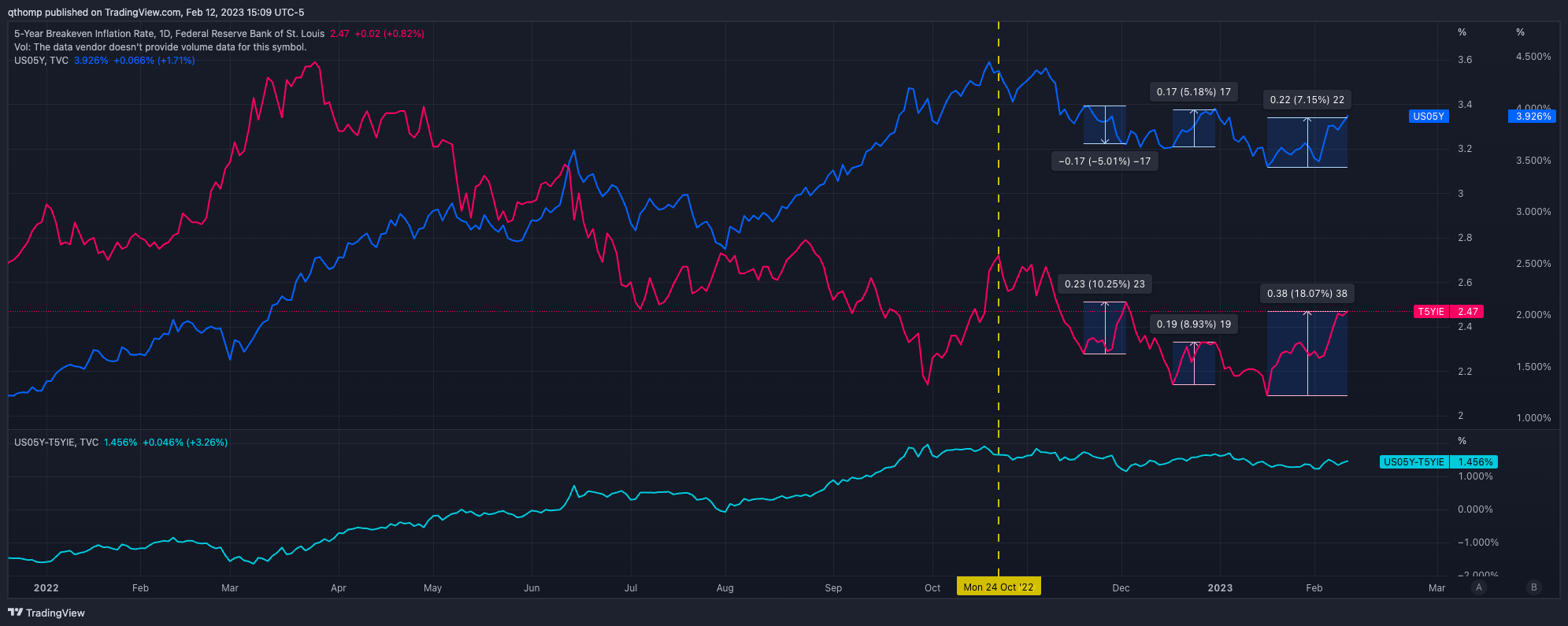
The economy is in too weak of a position whereby rates would only rise if inflation expectations moved meaningfully higher. We’re seeing this play out. October 2022 was the turning point when both nominal rates and inflation expectations peaked. Since then all rallies in nominal rates have coincided with larger increases in inflation expectations. The market screaming pause/pivot displays the Fed’s inability to tighten monetary conditions more aggressively and that inflation is the only way out of the debt bubble.
Nominal rates falling
Slower than inflation expectations - real rates higher, gold lower
Faster than inflation expectations - real rates lower, gold higher
The resilience of commodity prices and other inflation indicators highlight the difficulties facing a Fed who is fighting a supply driven inflation battle with a demand destruction hammer. Given the risks are skewed to the upside, it would take a severe recession for inflation expectations to fall dramatically and in this case the Fed would be forced to intervene akin to their COVID response. We’re seeing this play out already with commodity prices stabilizing despite economic indicators showing extreme weakness. The resilience of labor market data has provided a newfound wind in the sails of team soft landing. However the Fed is 12 months into their most aggressive hiking cycle in decades, yet inflation expectations are still at 15 year highs. Eventually they will face the decision whether or not to spare the economy (pause/pivot) or bring down inflation. Every indication points to the former.
Owning gold combines the benefits of being long commodities (inflation) in a soft landing and long treasuries in a deep recession, with way less volatility.
There’s actually another longer-term structural force at play too. As mentioned above, the Fed is fighting a supply driven inflation battle by trying to reduce demand. This may work in the short-term, particularly if inflation is a monetary phenomenon and it cannot resume in earnest without a Fed pause and pivot. However, the longer monetary policy remains restrictive, the worse the inflation issues become on the other side of this cycle. This is because much of the structural supply problems are interest rate sensitive like commodity production and infrastructure investment. Artificially restrictive monetary policy crimps the investment into these industries that would otherwise play out, exacerbating the long-term problems.
Why gold not other commodities like oil?
I am not convinced we will land softly. I believe labor data is both lagged and not representative of the actual underlying health of the economy. Therefore if we do see a recession and market sentiment shifts that way (heavily skewed soft landing today), I think commodities will get flushed, even if only briefly.
Why not digital gold (Bitcoin)?
I do not yet believe the risk/reward favors long tail technology assets with no cash flows. Induced either via recession/earnings decline or a soft landing/higher for longer interest rates, I believe tech is at risk of selling off further.